
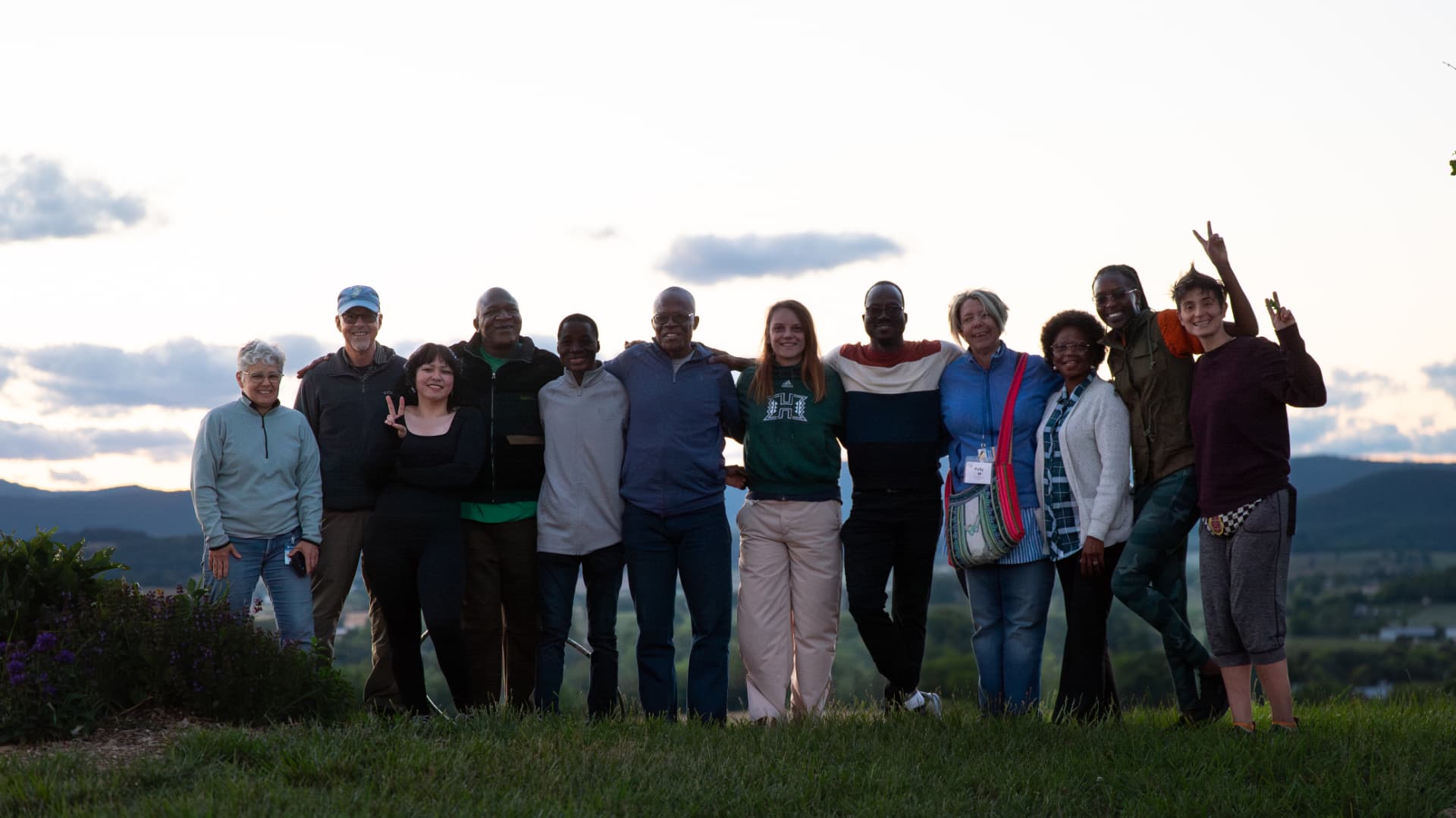

SPI peacebuilding participants gathered outdoors at sunset

SADRA × EMU Center for Justice & Peacebuilding

SPI South Africa

A new professional learning institute in Cape Town. EMU's 30-year SPI pedagogy, taught by a mix of African practitioners and US-based CJP practitioners.

5–15 January 2027 · Cape Town, South Africa · Applications close when all 100 seats are filled

2

Sessions in Cape Town

4

Practical Peacebuilding Courses

30+

Years of Peacebuilding Education

1

International Learning Community

Why this partnership

Peacebuilding education that no longer requires a United States visa.

For three decades, EMU's Summer Peacebuilding Institute (SPI) in Harrisonburg, Virginia has brought together practitioners from around the world. Yet visa restrictions, airfare and the cost of international travel have kept many from participating. SPI South Africa moves that classroom to the continent so that these barriers don't keep practitioners from learning together.

SADRA brings ten years of grassroots conflict transformation in township schools, women's leadership circles and community mediation across South Africa's metros. EMU's Center for Justice & Peacebuilding (CJP) brings a proven curriculum, innovative peacebuilding, restorative justice, and trauma methodology, alongside a global faculty network. Together: rigorous, rooted professional training at a fraction of the cost.

  • Professional training with a certificate of completion
  • A mix of African and US-based Scholar/Practitioners
  • Practical learning with real communities and live contexts
  • All fees charged in South African rand, with indicative USD estimates
Cape Town, South Africa and Harrisonburg, Virginia — the two homes of SPI South Africa

Curriculum

Four professional courses.

This professional institute will host four courses across two sessions. Session 1 runs January 5–9, and Session 2 runs January 11–15. Learning sessions are full days, 8–5, with lunch, coffee, snacks, and breaks provided. Participants are invited to choose one course from each session.

Participants receive a certificate of completion; no academic or graduate credit is awarded.

Session 1 · Course 01

Analysis: Understanding Conflict

Facilitated by Dr. Gloria Rhodes and Rev. Oscar Siwali

5 days

Explore what drives conflict and where change becomes possible. Through conflict mapping, systems thinking and examples from real world contexts, participants examine power, history, relationships and their own role as practitioners. Build practical tools to understand complex situations and identify opportunities for peacebuilding.

Session 1 · Course 02

Restorative Justice

Facilitated by Dr. Joe Cole and Rev. Phumzile Stofile

5 days

How can we respond to harm in ways that support accountability, healing and stronger relationships? Explore restorative justice principles and practices within community and legal justice settings. Through dialogue, case studies and practical exercises, participants consider whose needs matter, who holds responsibility and how people can move forward together.

Session 2 · Course 03

Mediation for Transformation

Facilitated by Rev. Oscar Siwali, Dr. Gloria Rhodes, and Dr. Joe Cole

5 days

Build skills to help people navigate conflict and create possibilities for change. Practise listening, mediation and community dialogue while exploring how power, identity and history shape disputes. Engagement with real community contexts connects classroom learning to local practice, with attention to transforming relationships and addressing the conditions that sustain conflict.

Session 2 · Course 04

Strategies for Trauma Awareness & Resilience Level 1

Facilitated by Dr. Katie Mansfield, Dr. Ram Bhagat, and Vuyokazi (Vuyo) Luxande

5 days

Explore how trauma affects our bodies, beliefs, behaviour and societies, and how to break cycles of violence. STAR brings together neurobiology, conflict transformation, human security, spirituality and restorative justice through theory and practical exercises. Participants gain tools to bring a trauma-informed perspective to their work, address current and historical trauma, and build individual and collective resilience, including through self-care.

Lodging & transport

Arrange your own stay; we'll help you get there.

Lodging is self-organized and self-paid. The program coordination team can help with transport to your lodging and with transport for daily attendance.

  • Accommodation is not included in the tuition fee
  • A range of guesthouses and short-stay options are available near the training venue
  • The coordination team can advise on transport to your lodging and for daily attendance

How it works

From application to arrival

01

Apply

One form, about 25 minutes. Course selection, a short practice statement and a biography.

Go →

02

Decision

A joint SADRA–CJP panel reviews rolling admissions within 14 days.

03

Pay or fund

At least 50% of tuition within two weeks of applying; full payment by 18 December 2026.

Go →

04

Onboard

Visa letters, pre-reading, housing and your arrival checklist.

The inaugural cohort opens with 100 seats.

Applications are reviewed on a rolling basis. Apply now to secure your spot!

Apply Now